My interest in photography did not begin with a manual. It began in front of a table holding three cameras. This article recounts that moment as a personal memory, keeps the documented context of the place separate and attributes no words or roles to anyone that I cannot verify.
The memory: one table, three cameras
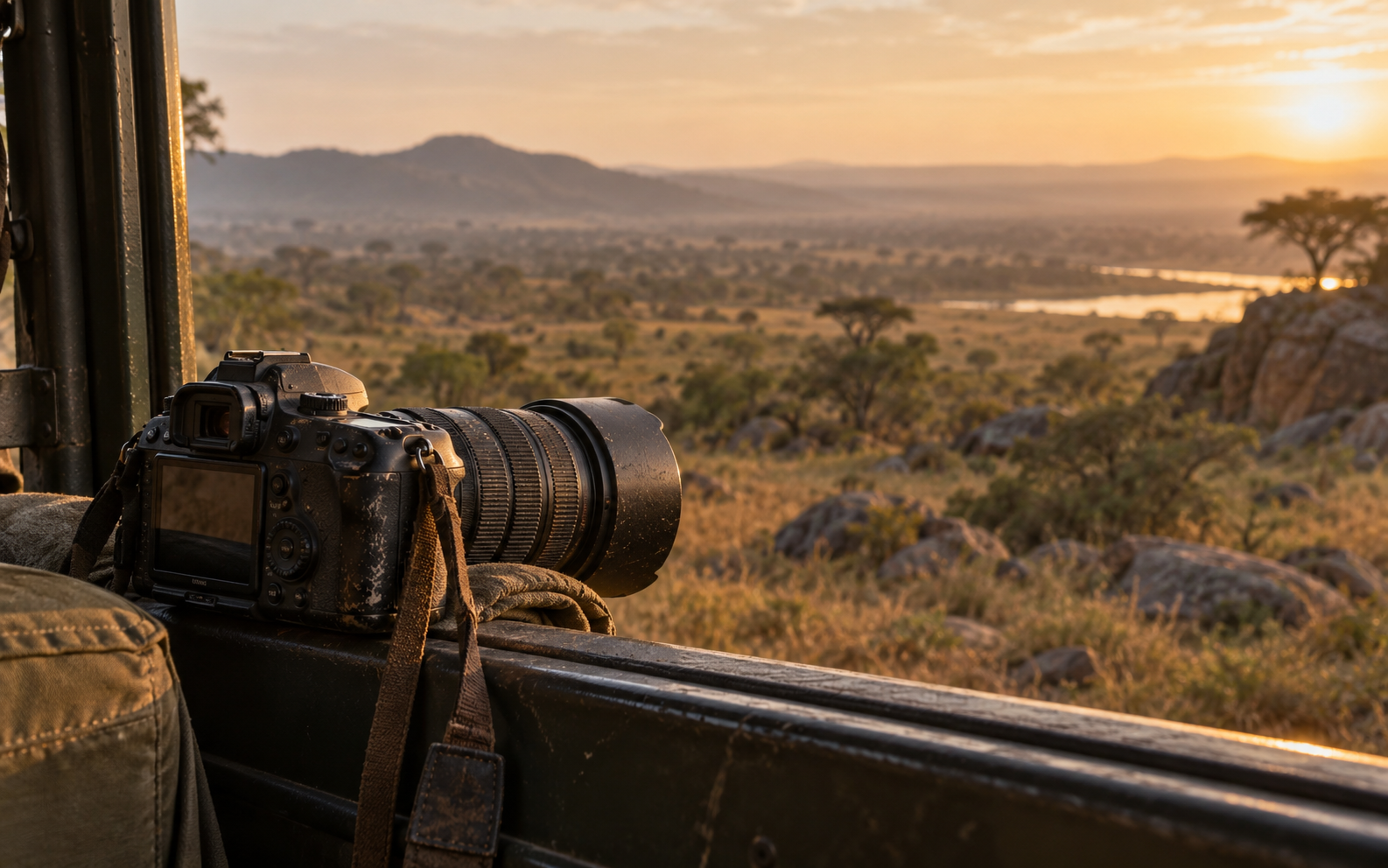
During a trip in 2010 or 2011 — I cannot remember the year with certainty and prefer to state that uncertainty — I met Carlo Landucci at Flatdogs Camp, near South Luangwa National Park. What remains particularly vivid is the table: three cameras, several lenses and a large telephoto lens resting to one side.
It was not the equipment itself that struck me, but the fact that it was there, being used, in the middle of an ordinary day. That table led to a conversation about photography and Africa. That conversation — not a course or a book — sparked my interest. I tell it as my own experience: I have no sources documenting the encounter, and I do not attribute quotations, positions or assignments to Carlo Landucci.
What changed afterwards
From that journey onwards, I began to look differently. Before then, I brought images home as memories; afterwards, I started asking why one photograph worked and another did not, how the light behaved at a particular time and what changed if I moved half a step. It was a gradual transition, without another equally clear turning point.
It was also when photography and travel stopped being two separate things. I was not photographing Africa as an exotic subject: I photographed because I was there, and because being present in that way required attention before technique.
The place, for those who do not know it
Flatdogs Camp is located near South Luangwa National Park in Zambia. A profile of the camp published by Zambia Tourism describes its location and character. The source provides context for the place; the encounter described here is not, and could not be, publicly documented.
My interpretation
Over time I realised that the conversation had given me a method more than a technique: observe before intervening. This is my retrospective reading, not an objective conclusion. It connects with the way I try to write about travel without placing myself at the centre, which I discussed in Africa is not a backdrop.
The simplest fact remains: had I not stopped at that table that day, photography would probably have remained a way of storing memories. Instead, it became the first language through which I learned to look.